Experts create rules for first ever airport in space
The Moon could soon become a busy hub for takeoff and landings as humans venture further into space, experts warn
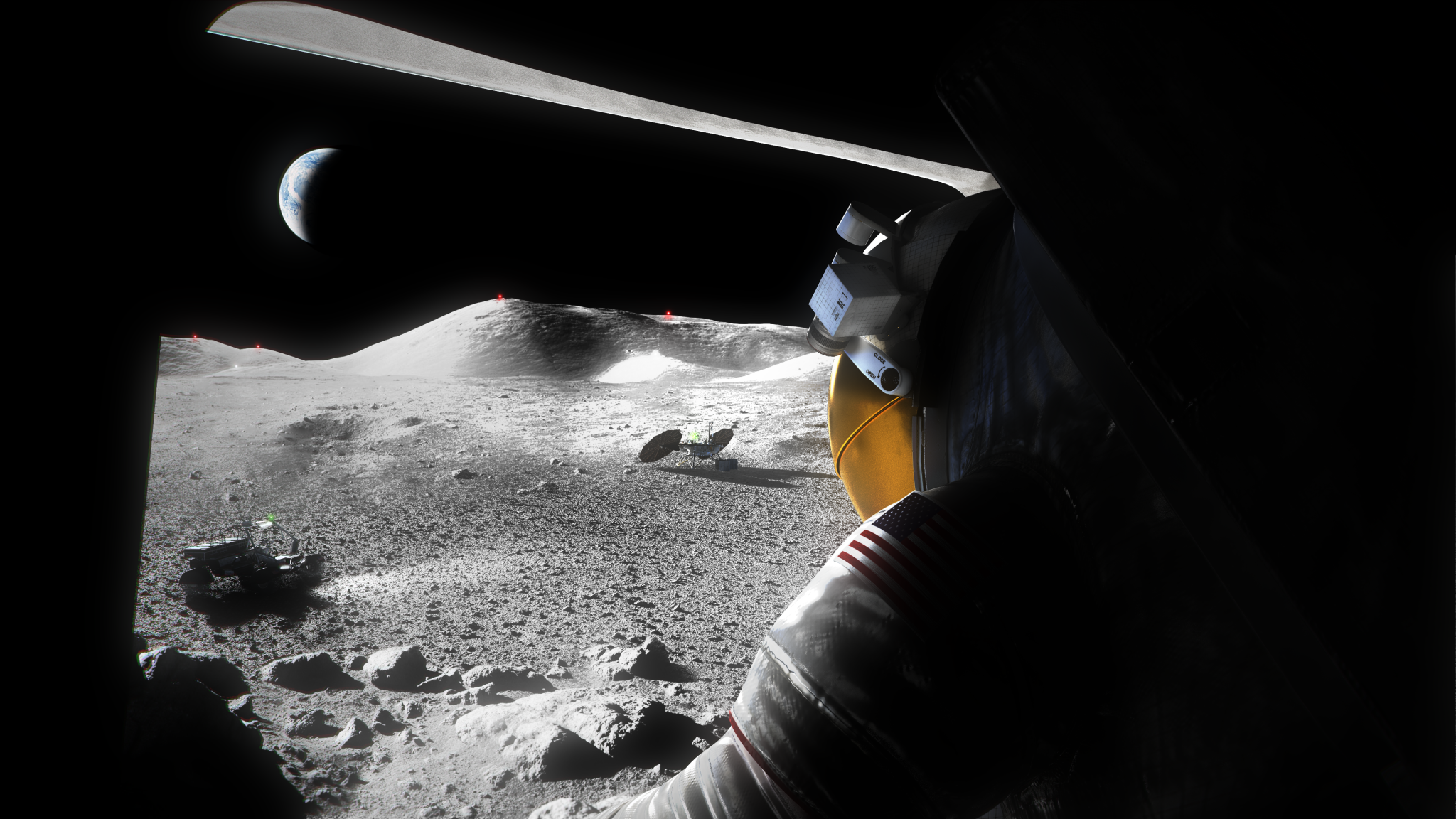
Experts have created rules for what could be an entirely new kind of airport: one on the Moon.
In the next couple of decades, the lunar surface could become a busy hub for space travellers. Nasa and other space agencies hope to soon build permanent habitations there, and use them as a way of both better understanding the Moon and as a stopping point on the way to travel deeper into space.
But those busy flights could eventually become complicated as astronauts and their spacecraft, cargo and other traffic fills up the area above the Moon. Nasa, for instance, has plans to build a “Gateway” that will serve as the first ever lunar spaceport to allow for regular takeoffs and landings.
Somehow, space agencies will have to ensure that the Moon has its own kind of air traffic to control, to ensure that spacecraft stay safe as they arrive at and depart from the Moon. Now, scientists have proposed a host of new rules that rely on mathematical laws to protect the journey between Earth, the Moon, and the rest of space.
The new study suggests a flight manual and orbital “rules of the road” so that multiple spacecraft can safely share the area around the Moon. It was assembled by experts at Nasa’s Johnson Space Center as well as researchers from Texas A&M and Purdue universities.
“The future of lunar exploration depends as much on the traffic management as it does on the rocket science,” said Diane Davis, associate professor of space engineering at the Texas A&M University College of Engineering, and an author of the study.
That will rely on a “celestial highway” that depends on gravity, the researchers say, and for Nasa’s Gateway and the spacecraft that visits it they will travel along a Near Rectilinear Halo Orbit, or NRHO. “The Gateway NRHO is a nearly stable and highly elongated orbit around the moon that provides an uninterrupted line of sight for communications to Earth and requires little propellant to maintain,” said Dr Davis.
The trouble is that this egg-shaped orbit is complicated by the competing gravity pulling from the Earth and the Moon, and also takes a vast, strange shape that means spacecraft could be 1,000 miles from the Moon’s North Pole or back out almost 40,000 miles beyond its south pole.
One space station can manage this with occasional thruster burns. But the complexity of multiple spacecraft – some of which might not have crew – ensuring that people stay out of each other’s way becomes more of a problem.
That will require the spacecraft to “loiter” just as aircraft will sometimes fly around an airport, or be held at a gate, as they await their time to land or take off. But spacecraft might have to wait for weeks for a similar time – and will be doing so in an environment where everything is moving all the time and comes with much bigger risks.
“Every spacecraft is constantly moving,” Dr Davis said. “It’s a Goldilocks zone of keeping ‘parked’ vehicles far enough from each other to be safe, but close enough to their destination so that resources are used efficiently.”
To fix that problem, researchers used computer simulations to test how they could keep vehicles carefully spaced out as they wait to land, as well as factoring in mistakes such as navigation problems or issues with thrusters. A small increase in manoeuvres should allow spacecraft to stay near their intended positions, they found.
That in turns should make the spacecraft more predictable and therefore easier to co-ordinate and keep safely in the air.
The work is reported in an upcoming paper, ‘Cislunar traffic management: Orbit maintenance and loitering in the Gateway NRHO’, published in the journal Acta Astronautica.
Join our commenting forum
Join thought-provoking conversations, follow other Independent readers and see their replies
Comments
Bookmark popover
Removed from bookmarks